

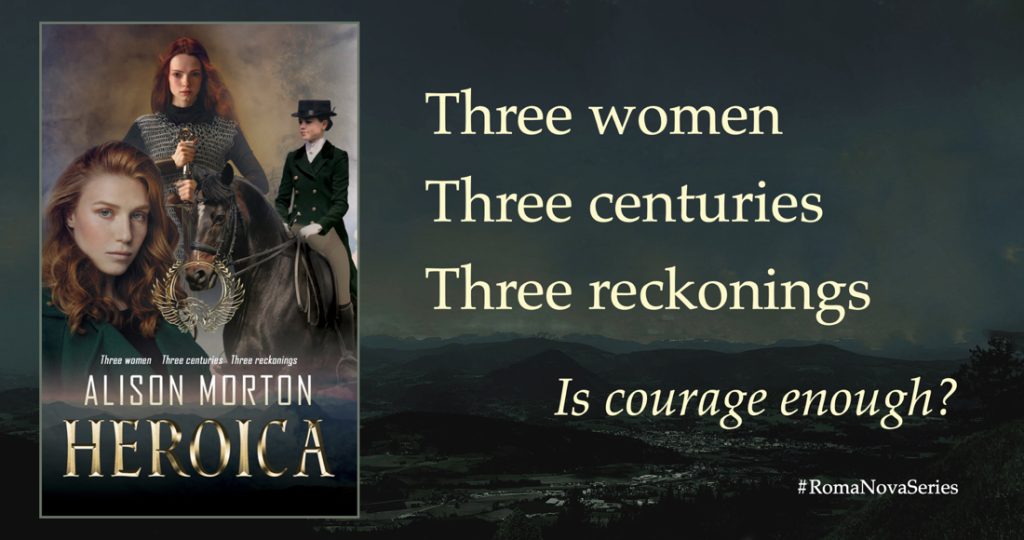
Today, I am helping Alison Morton celebrate her recent release, Heroica. There’s a review further down, but I am first going to turn you over to Alison’s capable hands – she’s written a post about language. Made me smile that, as I recall reading her first book and wondering just what on Earth “Stat!” meant. Turns out that is military speak for “NOW!” (Yup, in capitals)
Anyway, let’s start with Alison’s post about language:
Language – The cringe factor
If you’re on social media, you’ll see multiple lively ‘discussions’ about the use of language.
“I want to get the steak entrée with fries.”
vs.
“I’d like the steak with chips for my main course, please.’
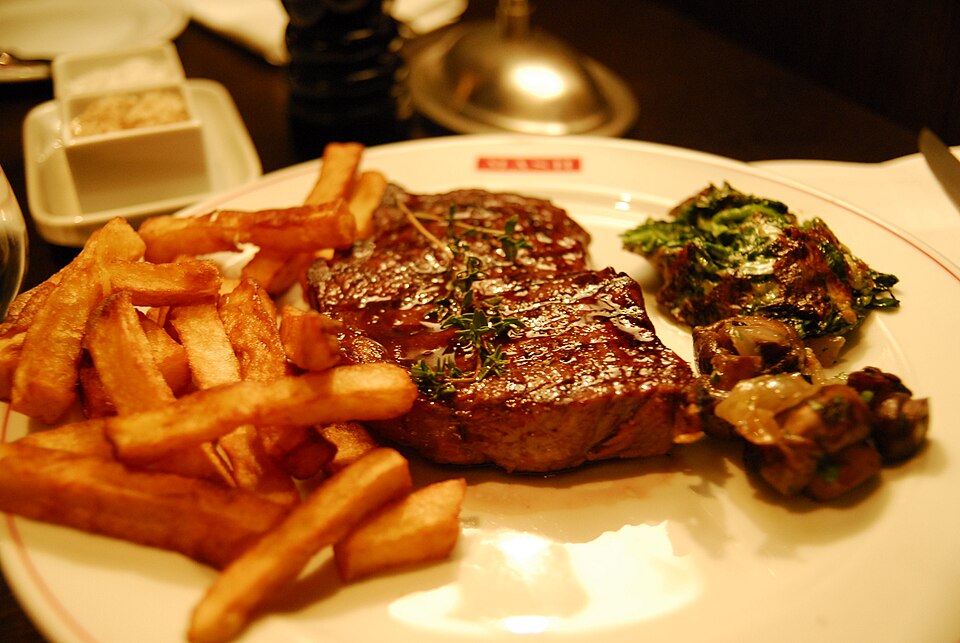
An exaggeration, of course, but both appropriate to their country and generation; likely to be a young American in the first instance and an older British person in the second. You can almost visualise the speakers by their words. And they’re enough to trigger numerous spiky comments in social media, some outraged, others hilarious.
Word appropriateness is a cornerstone for historical fiction writers.
A character’s vocabulary and sentence construction reflect values, education, occupation and social environment. In the past, religion and class should be added to that list.
In my new book HEROICA, the three stories are set in 2020, 1683 and the dual timelines of the present and 1849. Each main character speaks differently. Carina in the first story speaks as a 21st century young woman brought up in North America. She uses a relaxed vocabulary and the clause and sentence construction of such a speaker. In the present-day parts of the third story, she is ten years older and her speech has matured – a little.
Her ancestor in 1683, Honoria, in the second story uses a more formal way of speaking with no shortenings and uses slightly archaic turns of phrase. In the 19th century part of the third story, another ancestor, Statia, speaks more in the way we would recognise as how our grandmother or great grandmother with have spoken – formally, but using more modern words, although not 21st century ones!
Speech in dialogue can lay some fearsome traps for the historical fiction writers. I’ve collected together some examples of anachronisms – possibly exaggerated ones – but they illustrate the point that we must always be careful in our writing.
What should we look out for?
Modern psychology dropped into the past
“She knew he had commitment issues.”
“He needed closure.”
“She was processing her trauma.”
These are late-20th-century therapeutic concepts. A Tudor lady, a Roman matron, or a Napoleonic officer does not think in counselling vocabulary.
They might say:
· “He is inconstant.”
· “I cannot make sense of what happened.”
· “She is much afflicted in her mind.”
Corporate /office language in pre-industrial settings
“We need to touch base.”
“Let’s circle back.”
“He needed to manage expectations.”
This is boardroom English. If a medieval knight says this, the reader falls through a time portal. Depending on the era, we might substitute these for:
· “I need to meet you very soon to discuss matters.”
· “I fear we did not reach a conclusion when we last spoke.”
· “I am disappointed with X’s dishonourable behaviour in battle.” (or whatever situation)
Democracy words before democracy vocabulary existed
“The villagers voted to expel him.”
“They believed in human rights.”
“She fought for equality.”
These are post-Enlightenment political concepts. Even where collective decision-making existed in the past (rarely), the conceptual language did not. The villagers were much more likely to beat him up and chase him penniless and naked out of the village, all led by the village bully! I concede that the Greeks and Romans had some notions of democracy and could try and then vote in the Senate on the conduct of people of their class and potentially exile them, but this was very nuanced compared to how 21st century citizens see it.
So in the past, they might:
· “They shunned him”
· “They cried out for justice and fairness”
· “She sought to petition the lord” (But good luck with that)
Anachronistic descriptions of relationships
“They started dating.”
“He was her boyfriend.”
“They had chemistry.”
“Dating” is early 20th century usage. “Boyfriend/girlfriend” in the romantic sense is very modern. “Chemistry” for attraction is 19th–20th century metaphor.
Earlier:
· “they kept company”
· “He was paying court to her” or “They were walking out together”
· “They enjoyed the other’s company to a marked degree”
Scientific metaphors before the science existed
“Their plan had real momentum.”
“He had the bandwidth to deal with it.”
“She analysed the problem.”
“Bandwidth” is obviously modern tech, 1930s, but even words like analyse (17th century) and momentum (18th century for figurative, non-scientific use) wouldn’t be appropriate in medieval or classical settings depending on tone and usage.
I’d suggest:
· “Their plan was sound and strong on all points.”
· “He is fully competent to carry out this task.”
· “She considered the problem thoughtfully.”
Casual Americanisms in European pasts
“Okay.”
“Guys.”
“Got it.”
“Hang on.”
“No way.”
“Reach out”
A Viking, a Roman senator or a Regency lady does not say “okay.” Ever.
Legal / bureaucratic terms from much later periods
“He filed a complaint.”
Check the legal system of the time and use the vocabulary in contemporary documents, e.g. petition and who to approach.
“They had a protocol.”
They probably didn’t. Possibly “a custom” or “traditional practice” or “common usage”
“This violated policy.”
Policy – nope. Possibly “normal principles of conduct” or “the practice of good government.” But very dependent on the period
Therapy-speak emotions instead of period emotions
“She felt uncomfortable in her own skin.”
“He had low self-esteem.”
“She struggled with her identity.”
Pre-modern people did not conceptualize the self this way. They thought in terms of how they were seen by their society in terms of :
· Honour, duty, virtue
· Shame, sin, reputation
Even though social norms changed beyond recognition in the twentieth century, those prevailing in 1900, 1950 and 1999 were vastly different from each other and so was the language and level of introspection.
The most invisible mistake: tone modernity
This is the hardest one to spot.
An example is a Roman woman from any time in the 1,200 years that Ancient Rome lasted saying: “I’m not sure this relationship is working for me.”
Every word may technically be old. The mindset is not. “Relationship” dates from the 1640s and meant “a sense or state of being related by kindred, affinity, or other alliance”. It wasn’t used to indicate romantic or sexual intimacy until the mid 1940s.
The sentence above illustrates 21st-century individualism. A Roman woman may be unhappy, fearful or feel neglected, but she would frame the relationship in terms of family, duty, alliance, property, honour or fertility – not personal emotional satisfaction. Of course, until Christian times, divorce was nearly always possible for a Roman.
The rule of thumb
Keep it neutral and simple, even formal. Don’t be tempted to go to the other end and use terms such as “prithee, varlet” and similar over-mannered speech. Use nature, weather, natural building materials, food, furniture, cooking materials, religion, contemporary speeches and literature for figurative speech.
An invaluable resource for checking the usage dates is https://www.etymonline.com.
Another tip is to look up the English word in a foreign language dictionary – the oldest one you can get hold of. If the word doesn’t exist in that language, it’s an indicator that the concept or facility didn’t either.
If the phrase sounds like therapy, HR/corporate-speak, a university lecture, a podcast, cool conversation between 21st century BFFs, it probably doesn’t belong in 500 BC, 50 AD, 1066, or 1683. Perhaps readers won’t consciously know why it feels out of kilter, but you can bet your bottom dollar, thaler or solidus they will know instinctively it’s wrong. That will break the moment, jolting the reader out of the story. And nobody wants that.
*****
Thank you, Alison. And now, onto the book!
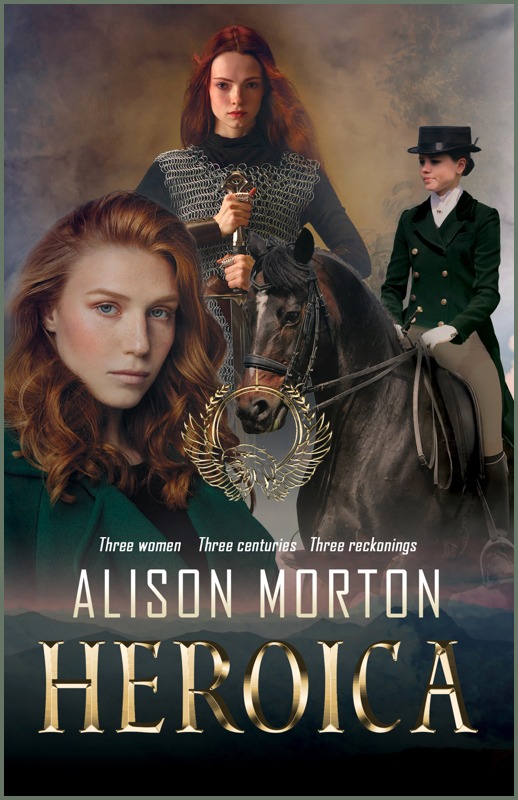
Even the strongest state is vulnerable to its past
2020, Roma Nova. Carina Mitela investigates a potential rebellion but discovers the long-buried secret that ignited the attempted uprising links directly to her own powerful family.
1683, Vienna. As Europe struggles against the Ottoman onslaught, Honoria Mitela leads her troops into the desperate battle to save besieged Vienna. The fate of Europe – and of Roma Nova itself – hangs in the balance.
1849, Central Italy. Statia Mitela’s impulsive act saves one life but jeopardises Roma Nova’s very existence and threatens her descendants with public disgrace, financial ruin and permanent exile.
———–
Three stories of the women of the Mitela family, descendants of the founders of Roma Nova, bound by blood and courage.
Buying links for HEROICA Amazon
Other retailers
My review
There is something titillating about the notion of a country where women have ruled since the dawn of time. Add to this a nice Roman twist, and you have a little country called Roma Nova, a remnant of the Roman Empire that has somehow managed to survive through the centuries—very much due to their strong women and a firm belief in gender equality.
Over the years, Ms Morton has created her own little alternative history universe, one in which the global map doesn’t quite look like it really does, but where political tensions are just as prevalent. For a very, very small country, it is paramount to balance these tensions to survive—and this is something Roma Nova excels at. But sometimes, this leads to conflict between what is politically the right thing to do and what is the most moral thing to do—as Statia Mitela discovers in the third of the short stories included in this little collection.
The three stories all have a strong female lead in common. I have a particular fondness for Carina Mitela, our present day heroine, and always enjoy just how action-packed things become when she is around. Revolution?, the first story, is no exception, but as always, Ms Morton tempers the thrills with vivid descriptions, creating a strong sense of place. She also has me reading up on Publius Clodius Pulcher—an IRL ancient politician that happily enticed the masses to cause chaos.
In the second story, Honoria’s Battle, Ms Morton has us witnessing the battle of Vienna in 1683. Skilfully, she weaves her invented Roma Novans into the real history of the event, in which the Polish king John Sobiesky and his forces play a central role. Honoria Mitela is there to help, but Roma Novans are viewed askance by the Christians—they’re pagans, after all—and so a certain level of caution needs to be exerted. For all Honoria’s tough-as-boots persona, she is not immune to a sudden coupe-de-foudre, making her very relatable.
The Idealist has us accompanying Statia Mitela to Italy—more precisely to Rome. She thinks she has silent approval for what she is planning to do, but greed can make monsters even out of senior Roma Novans—as Statia will come to discover. This last story is a dual timeline story, allowing Carina to do some research into her own family’s darker secrets.
All in all, Ms Morton has yet again delivered an enjoyable read set within her Roma Nova universe. Personally, I am looking forward to more books about this little republic!
*****

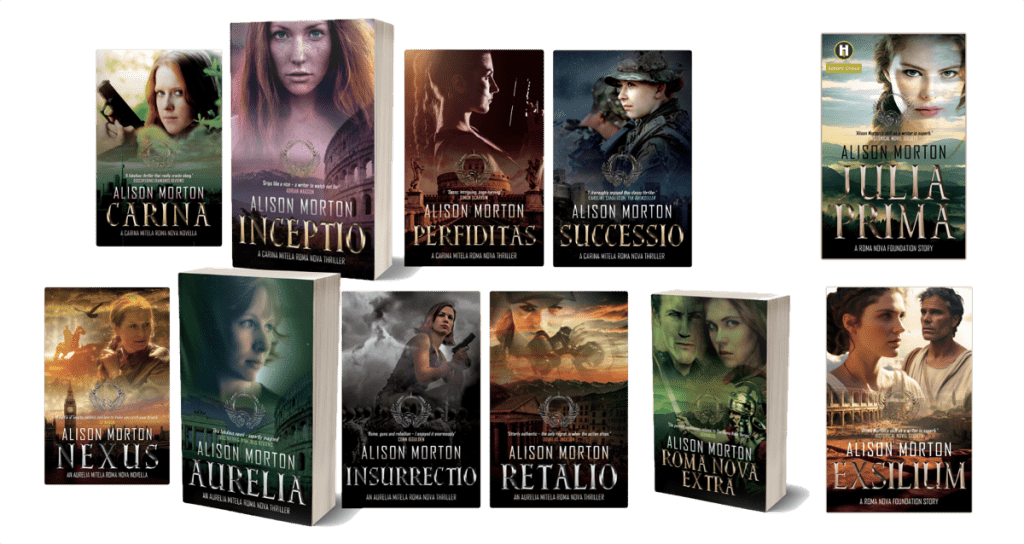
Alison Morton writes award-winning thrillers featuring tough but compassionate heroines. Her twelve-book Roma Nova series is set in an imaginary European country where a remnant of the Roman Empire has survived into the 21st century and is ruled by women who face conspiracy, revolution and heartache but use a sharp line in dialogue.
She blends her fascination for Ancient Rome with six years’ military service and a life of reading crime, historical and thriller fiction. On the way, she collected a BA in modern languages and an MA in history.
Alison lives in Poitou in France, the home of Mélisende, the heroine of her two contemporary thrillers, Double Identity, Double Pursuit and Double Stakes
For the latest news, subscribe to her newsletter at https://www.alison-morton.com/newsletter/ and receive ‘Welcome to Alison Morton’s Thriller Worlds’ as a thank you gift.
Social media links
Connect with Alison on her World of Thrillers site: https://alison-morton.com
Facebook author page: https://www.facebook.com/AlisonMortonAuthor
Alison’s writing blog: https://alisonmortonauthor.com
Instagram: https://www.instagram.com/alisonmortonauthor/
Goodreads: https://www.goodreads.com/author/show/5783095.Alison_Morton
Alison’s Amazon page: https://Author.to/AlisonMortonAmazon
Threads: https://www.threads.net/@alisonmortonauthor
BlueSky: https://bsky.app/profile/alisonmorton.bsky.social
Twitter/X: https://twitter.com/alison_morton @alison_morton
Newsletter sign-up: https://www.alison-morton.com/newsletter/
*************
Don’t forget to check out MY books!
Into medieval historical fiction? Check out The King’s Greatest Enemy or The Castilian Saga.
Prefer time-travelling? Check out The Graham Saga and The Time Locket

Thank you so much for hosting HEROICA for its launch. I had to reply stat! Language is our writing tool, but we must always respect it and guide it along the right path.
My pleasure, Alison
Congratulations to Alison on her new release! She is a wonderful writer. I recently had the pleasure of reading Exsilium :)
Wonderfully observed. Dialogue in historical fiction does far more than convey information; it reveals class, education, faith, and worldview. A single modern phrase can break the illusion of the past instantly. Authentic dialogue is not about excessive archaism, but about capturing how people of another age understood themselves and the world around them.
True. It is important to not overload dialogue with attempts at writing how “they spoke back then.” None of us know how they did speak – but avoiding modernisms is always wise.