

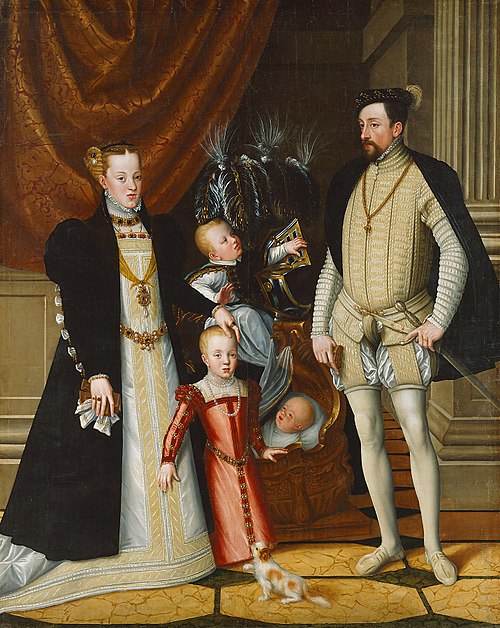
It has been quite some time since I indulged in my fascination with the Hapsburgs, this once so powerful family that controlled most of Catholic Europe and preferred to marry very close kin—which, eventually, led to disaster, at least for the Spanish Hapsburgs.
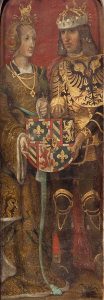 Mary and Maximilian, side by side as equals
But the Hapsburgs weren’t always an inbred dynasty on the brink of genetic collapse. The man responsible for propelling the Hapsburgs from relative obscurity in the Austrian hinterlands to the limelight of European politics, Maximilian Hapsburg, did not marry a cousin. No, he rode at haste across Europe to come to the aid of his betrothed, Mary of Burgundy, who was presently under heavy pressure from the French king. Maximilan saved the day, wed his bride, welcomed two healthy children—and then Mary died in a riding accident. For a while there, life screeched to a stop for Maximilian, but soon enough he was back to managing his various holdings which now also included Burgundy, on behalf of his son, Philip the Handsome.
Philip the Handsome had little say in who he was to wed—daddy arranged things with those Most Catholic majesties, Isabel and Fernando of united Spain, and so Philip ended up married to Juana of Castile. Philip’s sister, Margaret, was married to Juana’s older brother, but as he died at a very young age, as did Juana’s older sister, suddenly Juana stood to inherit Castile and the recently discovered territories in the New World and the Hapsburg dominions expanded significantly. Now, Philip and Juana were not cousins, but Juana came from a family who also preferred to wed close kin—which may explain why she became so unstable after Philip died. Or maybe it is as simple as Juana’s father being reluctant to abdicate from power so he painted his daughter as being somewhat off her rocker. . .
Juana and Philip had six children all told. The eldest, Charles, was to destined to become one of the most powerful men in Europe. His education was carefully managed by his grandfather (while he was still alive) and by his impressive aunt, Margaret Charles grew up with German as his first language and had not visited Castile until the day he arrived there in 1516 to claim the crown (officially as a co-regent with his mother, but he preferred to handle things on his own, i.e. he kept his Mama under lock and key. Not the most dutiful of sons. . .)
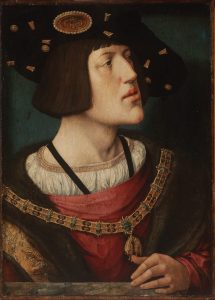 Charles V (I)
In today’s post, Charles is not the protagonist. He is more like a constant presence. But before we leave Charles, I think we must point out that he deffo had the Hapsburg jaw that was to become increasingly more prominent the more inbred his descendants became. His great-great-grandson and namesake, Charles II, would find it hard to eat or talk due to it.
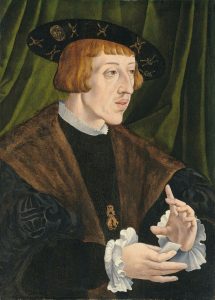 Ferdinand I
Charles’ brother, Ferdinand, does not seem to have had said jaw – or at least not quite as prominently. Nor was he raised in Mechelen with his brother—no, Ferdinand was sent to live with his maternal grandfather and namesake Fernando, there to be raised in an adequately Spanish way. Accordingly, when in 1519 the still teenaged Charles V (and I) became Holy Roman Emperor and decided his brother would best serve him as regent of Austria, Bohemia and Hungary, Ferdinand had a lot of catching up to do as he did not speak German. Fortunately, Ferdinand was both diligent and intelligent.
So why did Charles decide to name Ferdinand, at the time all of sixteen, as his regent? Well, it likely had something to do with Ferdinand’s wife. I give you one of the true Hapsburg matriarchs, Anna Jagellion, daughter of Vladislau II of Hungary and Bohemia.
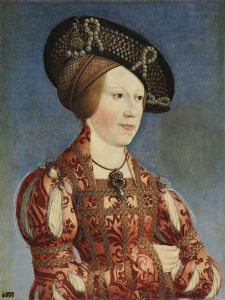 Anna of Bohemia
Usually, she is referred to as Anna of Bohemia, but I just have to take a moment to gush a bit over another dynasty find interesting, namely the Jagellions. This originally Polish-Lithuanian dynasty had since quite some time been a powerhouse in—ttaa-daa—Poland andLithuania, but through a series of clever marriages plus the sad fact that the kings of Hungary and Bohemia failed dismally at producing male heirs, the eldest son of Casimir V of Poland, Vladislau, ended up as King of Hungary and Bohemia. His much, much younger brother, Sigismund I, would eventually become king of Poland and would father several children, one of whom was Katarina Jagellonica Katarina would, despite her VERY advanced age (thirty-three, peeps: borderline on her deathbed…) marry the much younger and rather dashing Prince Johan of Sweden. After a series of tribulations, she would become Queen of Sweden—a rather interesting situation, seeing as she was very Catholic and Sweden was becoming a rather intolerant Protestant kingdom.
Enough about Katarina, back to Anna who was born and raised in Buda (present day Budapest) until that day in 1516 when her father died, leaving his thirteen-year-old daughter and his somewhat younger son, Louis, as wards of Maximilian Hapsburg. Several years earlier, Vladislau and Maximilian had agreed that Anna was to marry Ferdinand and Louis was to wed Mary, sister to Charles and Ferdinand. In the contracts, it was clearly specified that should Louis die without male issue, Anna would be his named successor, thereby further expanding the Hapsburg influence.
Anna and Mary were to spend the coming years together in Innsbruck, their education spanning everything from hunting, fencing, dancing and, of course, more traditional subjects. I imagine both girls emerged well-equipped to stand by their future husbands in all matters.
Anna and Ferdinand were formally wed in 1521. They were about the same age but had little common ground when it came to culture or language, at least initially.
In 1521, Europe was undergoing quite some religious paroxysms, what with a certain Martin Luther having taken it upon himself to leverage the potentials of that new social media, the printing press, to challenge the Holy Roman Church on a number of issues. And no, dear peeps, we will not diverge into what exactly it was that Luther was up in arms about (it wasn’t only the indulgences…), but what is important to understand is that in some parts of the Ferdinand-Anna lands, specifically Bohemia, Luther’s thoughts found fertile ground, Protestants living side by side with the Hussites that had been around for a century or so. (The Hussites were followers of Jan Hus, another would-be reformer of the church who ended up burned at the stake)
Initially, I suspect the established church and its secular defender, i.e. the Holy Roman Emperor—our very own Charles—assumed the furore around Luther and his teaching would die down. But in difference to earlier reformers, Luther was exceedingly skilled at getting his word out (see printing presses above)
For our young, recently wed couple, Luther was not top of mind. After all, in Austria, the Holy Church was unthreatened, and while Bohemia could be an issue, it wasn’t yet. No, during the early 1520s, Ferdinand and Anna had other things to worry about—like why was there no pitter-patter of small feet. This became even more of an issue when Louis, Anna’s brother, died without heirs. Now Anna was Queen of Hungary and Bohemia, but to secure those lands for the Hapsburg empire, there had to be an heir.
Fortunately, in 1526, Anna was delivered of a healthy daughter, and the next year came the much-desired son, Maximilian. Over the coming two decades, Anna would present her husband with a further thirteen children, of which all but two would reach adulthood.
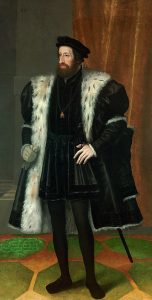 Ferdinand I
Over the years, Ferdinand and Anna formed a strong union, one of deep affection and trust. Ferdinand relied on his wife to manage things when he was away, appointing her as his regent when he was gone for longer periods.
In 1531, Charles V named his brother as his successor as Holy Roman Emperor. Not that this was entirely in his hands—the Holy Roman Emperor was elected by seven electors—but the clout of Charles (and Ferdinand) was such that it was likely a given. To formalise this decision, Ferdinand was elected King of the Romans in 1531 (essentially an equivalent to Prince of Wales, i.e. first you were king of the Romans, then, in the fullness of time, you became Holy Roman Emperor)
In the intermediate years, Luther’s words had caused a lot of upheaval. While Charles had outlawed Luther at the Diet of Worms in 1521, he’d let him leave unscathed so as to honour the safe-conduct he’d given him. In the intervening years, there had been two major Protestant rebellions, and Charles had found it wise to be somewhat conciliatory to these misguided people—principally because many of the German princes and other rulers of minor duchies and principalities were embracing this new faith.
Charles never wavered in his loyalty to the Catholic church. Ferdinand, however, seems to have been intrigued by these new teachings, and although he never converted, he tended to be sympathetic to those with Lutheran beliefs. As the tensions between Lutherans and Catholics began to escalate, Charles became more intolerant, and he did not like it that his brother was more into appeasing than arresting and jailing the heretics. He was especially concerned about Ferdinand’s eldest, Maximilian, who had not only studied Luther’s teachings but also corresponded regularly with openly Protestant people.
Having Charles hector him was not exactly pleasant, but Ferdinand had other matters that weighed significantly heavier on him. In 1547, his beloved Anna had died after birthing a little girl. Ferdinand would never remarry, wedded to the memories of his wife. Plus, he had a veritable football team of children to arrange marriages for, even if much of that arranging was done by Charles.
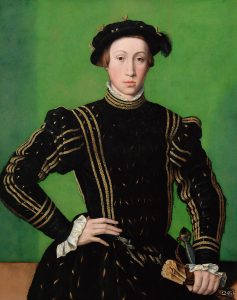 Maximilian at the age of 17-18
Charles took a special interest in Maximilian, this young man who seemed to teeter on the edge of becoming a heretic. That would not do. At all. In fact, there were days when Charles seriously regretted having decided to name Ferdinand as his successor as Holy Roman Emperor, because after Ferdinand would come Maximilian and none of them seemed to have the backbone required to lead the Counter Reformation which had been kicked off at the Council of Trent in 1545. What Maximilian needed, according to Charles, was a genuinely devout Catholic wife—like his own daughter, Maria.
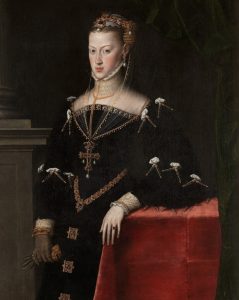 Maria
MariaMaria of Spain was extremely Catholic, to the point that she brought her own court with her to Vienna and refused to have anyone not a die-hard Catholic in her proximity. She and Maximilian never saw eye to eye on this, but strangely enough, theirs was a very successful marriage, despite the religious contention. Maria was to give Maximilian sixteen children, of which nine would make it to adulthood. Given that Maria was the product of a first-cousin marriage (Charles married Isabel of Portugal whose mother was his aunt) and that she and Maximilian also were first cousins, maybe it is no wonder so many of the babies died. To further compound things, their eldest daughter, Anna, was married to her uncle, Philip II of Spain. She would give her uncle/husband five children of whom only one would survive to become Philip III (and wed his cousin, Margaret of Austria . . .)
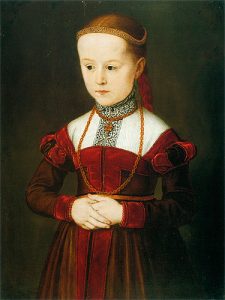 Little Anna, future queen of Spain, as a child
But Maria was more than a baby-making machine. Much, much more, seeing as she was extremely capable. I must say that neither Charles nor his son, Philip II, ever had any problem elevating women to positions of power, and Maria was to serve as regent of Spain not only for her father, but also for her brother. This meant long separations from her husband, but that was par for the course if one was a Hapsburg: duty first. Always.
 Rudolf II
Given Maximilian’s basic tolerance towards Protestants, Maria made it her special task to raise her children as very devout Catholics. Her eldest son, Rudolf, was sent to live in Spain with his uncle, Philip II and returned several years later as a very stiff young man. However, when he became Emperor he was inclined to tolerance rather than persecution—plus, he had a major war against the Ottomans to handle. Rudolf never married, and his tendency to placate various religious factions would, ultimately lead to the defenestration of Prague in 1618 and the Thirty Years’ War. By then, Rudolf had been deposed and replaced by Matthias, his younger brother.
It is somewhat sad to note that despite their nine surviving children, Maria and Maximilian only had one surviving grandchild, the future Philip III of Spain.
In difference to that, Anna of Bohemia’s thirteen children generated a massive 41 legitimate grandchildren that lived to adulthood. And yes, one of those grandchildren, Maria Anna of Bavaria, was wed to her maternal uncle, Charles and became the mother of a future Holy Roman Emperor, Ferdinand II. What I can’t quite get my head around when it comes to all this Hapsburg intermarriage is how they managed to get papal dispensations. The Church never condoned marriage between those closely related, but I suppose a Holy Roman Emperor can always twist a pope’s arm!
Should you want to continue reading about the Hapsburgs, why not catch up on the following posts:
His Empress, His love – of Isabel, Charles V’s wife
When a Spanish senorita set an English princely heart aflutter
Ana, Spanish princess, French queen
Niece, cousin and wife rolled into one