


Today, Nancy Jardine is back. Remember Nancy? She kicked off this month of female history with a post about Cartimandua, ancient British queen. Today, she has frog-leaped forward to the 19th century, with a post about a woman I had never heard about. But Nancy, I promise: next time I am in Edinburgh, I will deffo study the statue of David Livingstone! With that, I turn you over to Nancy’s capable hands as she tells us about the 19th century sculptor Amelia Robertson Hill.
*****
If asked to name a male sculptor then my first thought would be Michaelangelo Buonarroti, his statue of David being so famously stepped past by more than a million tourists each year, in Florence, Italy. If I was then asked to name a female sculptor I would have struggled till I encountered Amelia Hill. You might well ask – Who? Or – Do millions of people walk past anything created by her? The answer is a resounding, yes, because it’s estimated around fifteen million tourists and local people walk past her work every year! No, she doesn’t have Michaelangelo’s reputation but here’s a little bit about a Victorian Scottish sculptor named Amelia Robertson Hill.
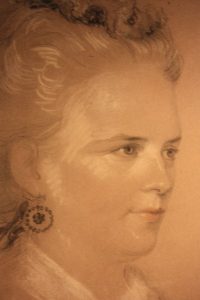 Amelia Robertson Hill
Born in Dunfermline, Fife, Scotland, on 15th January 1821, her birth name is recorded as Emmilia McDermaid Paton. Her parents were damask designers for the local textiles industry (Joseph Neil Paton–Victoria and Albert Museum), her mother a particularly busy lady since Amelia’s brother, Joseph Noel, was born in December 1821. Joseph Noel became a reputable artist, sculptor and illustrator who gained a knighthood. (Sir Joseph Paton) Another brother, Waller Hugh Paton, was a landscape artist. Further siblings did not survive much beyond childhood, otherwise there might have been more important artists and sculptors from this highly talented family.
Amelia, apparently, lived at home in Dunfermline till her mother’s death. On her father’s remarriage, she moved to Edinburgh to live with her younger brothers who had by that time gained reputations as fine artists – a feat much easier to accomplish for a man than a woman at this time. This may have been when she first exhibited at the Royal Scottish Academy of Art and Architecture, and trained with Edinburgh sculptor William Brodie. (Brodie sculpted the famed statue of the dog Greyfriars Bobby 1872). Living with her brothers meant she embroiled herself in the Edinburgh artistic scene but that situation improved even further in 1862, when at the age of forty-one, she married David Octavius Hill.
David Hill, a friend of her brother Joseph, was a painter and pioneer photographer some twenty years older than Amelia. Hill was secretary of The Royal Scottish Academy of Art and Architecture, so Amelia met the most prominent Scottish artists. Though denied entry to the Royal Scottish Academy, being female, Amelia’s work gained sufficient notoriety and she was awarded a number of important public commissions, an incredible achievement for a woman in Scotland during the era. Her feelings regarding gender bias aren’t recorded but it’s important to note that an alternative arts society which Amelia helped create in 1877 – The Albert Institute – opened its arms to artists regardless of gender.
During the 1860s, Amelia helped David Hill with an immense painting that took him 23 years to complete. ‘The Disruption’ is not only famous for its size and its composition but also for the fact that the faces of those present are said to be very good likenesses of those depicted. Along with a friend Robert Adamson, David Hill had become proficient in producing very innovative calotype photographs. Hill used many of the calotype prints and pencil drawings to paint accurate faces. It’s likely that Amelia used a similar technique to create her own additions, demonstrating her expertise as an artist.
After David Hill died in 1870, Amelia sculpted a stunning bronze bust of him which can still be viewed above their shared grave in Dean Cemetery in Edinburgh. She went on to create many other works in stone, marble, and bronze – mainly busts of notable Scottish people – which can be found in locations dotted around Scotland, or were exhibited at the Royal Scottish Academy.
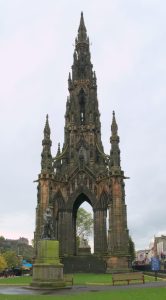
She was the main female contributor to the Sir Walter Scott Monument, a very famous edifice in Edinburgh that is walked past by some fifteen million people every year. The Sir Walter Scott Monument, the second largest monument to any writer across the globe, stands in Princes Street Gardens, near Waverley Station, which is itself named after Walter Scott’s series of Waverley novels.
The towering Victorian Gothic main structure was inaugurated in 1846, though the sixty-eight statues which embellish the buttresses and arches were gradually added between 1846 and 1882. It’s not easy to see the details from ground level but Amelia Hill’s work represents Richard the Lionheart (Ivanhoe; The Talisman and The Betrothed) and Minna and Magnus Troil (The Pirate).
Amelia Hill’s not nearly well-enough recognised as a sculptor because just a few steps away from the sometimes-overwhelming Scott Monument is another work by her, that of the missionary explorer David Livingstone. The bronze statue of Livingstone, standing on a high pedestal, depicts the explorer holding his bible with a pistol and compass at his waist (1876). Tourists often stop and appreciate the fabulous sculpture but the name of its creator tends to be given a cursory glance.
Amelia Hill also designed a statue of the famous Scottish poet Robert Burns which can be found in Dumfries, though the carving of the marble was done in Italy by Cararra sculptors.
If you happen to be a tourist in Edinburgh, at any point, then please spend a moment appreciating the work of the most important 19th Century female Scottish sculptor Amelia Robertson Hill.
Anna: I must admit I have never heard of Amelia – thank you for introducing me to her! And now onto an excerpt from Nancy’s book, Novice Threads:
1850s Edinburgh
Margaret Law is in the parlour tutoring her disabled pupil, Rachel Duncan, when Rachel’s siblings and her Forbes cousins from Inverness enter.
“You really must see the statue of Sir Walter Scott in his monument on Princes Street,” David said, encouraging the interest of his young cousins.
Victoria wasn’t quite so cheery. “Why would that appeal to them? They won’t know who he is.”
“I do know who he is!” Arthur was miffed. “I have read some of his novels already.”
Margaret decided Victoria must have lost some sleep, for the girl’s tone was more petulant than usual when she said, “It’s just a monument.”
David launched in to calm the atmosphere. “There’s a Carrara marble statue of Sir Walter Scott and his dog, Maida, at the foot of the monument, and there’s a great story about its journey to get there.”
Victoria wasn’t going to remain silent.
“I read that John Ruskin…”
Margaret watched Victoria’s dramatic attempt to gain the full attention of the younger children.
“You won’t know it, but my friend says Ruskin’s a very great art critic.”
The less than subtle pauses from Victoria made Margaret repress a grin.
Victoria rumbled on with, “Well. Ruskin wrote that the monument David is describing is just a vulgar Gothic steeple.”
The expressions on the faces of the children around her seemed impressed, if more than a bit forced, though Margaret secretly guessed they had no idea what Victoria was talking about.
David, she was glad to see, remained unruffled by Victoria’s rude interruptions. She watched him bend down to be more at eye-level with little Ruaridh.
“There’s a marvellous view from the top of the steeple, though you have to climb a lot of steps to get up to the viewing platform.”
“How many steps?” It was clear to see that Brian was much more interested in David’s information than Victoria’s.
David’s eyes glowed. “More than two hundred and eighty steps.”
“Is his dog at the bottom because it couldn’t climb up to the top?” Ruaridh asked.
Margaret watched most of the children grin at his naïve question.
David was so patient. “I’m not sure any dog could climb that number of steps up a very narrow and steep staircase, but Walter Scott’s dog is at the bottom of the monument because it’s part of the carving. You’ll see it if we venture down to Princes Street.”
Victoria’s nose was in the air, but Margaret sensed the girl actually was interested in what her brother was saying. “What’s your great story about the statue?”
David proceeded to explain how a sculptor would take a huge block of stone and would gradually remove what he didn’t want to create what he did want his viewers to see.
“The first block of marble was dug out of a quarry at Carrara in Italy. That’s where the best white marble for statues comes from.”
“And?” Little Ruaridh was enthralled.
Margaret looked out of the window to hide her smiles. David was stretching out his story with great dramatic delivery.
“When they lifted the huge block of marble onto a ship to get it to Edinburgh, it was so heavy that…”
Rachel’s animated tones interrupted. “I remember reading about this with Margaret.”
David’s stern looks shushed Rachel, who, in turn, began to giggle.
Three pairs of Forbes’ eyes stared at David.
“It sank the ship!”
“Oh, my!” Brian said. “But there’s a statue here, so how did they get the block out of the water?”
David playfully ruffled the boy’s hair.
“It was a different huge block from the quarry that they shipped to Edinburgh, successfully the second time.”
Rachel’s excited voice piped up. “Do you remember, Margaret? The newspaper we read said that it took twenty horses to drag that piece of marble up to the sculptor’s studio so that he could start work.”
Margaret agreed. “And then it took Sir John Steell, the sculptor, six years to complete the carving.”
“Steell?” Ruaridh chuckled merrily. “That’s a funny name for someone who didn’t work with metal but with a big bit of stone.”
After a general chuckling session, Margaret was quite relaxed when they turned their attention to playing card games, guessing games, and then closer to luncheon time stories of what life was like for the Forbes children in Inverness.
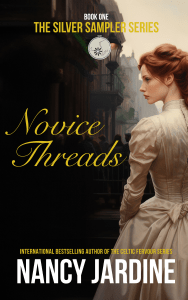
Blurb:
1850s Scotland. Growing up brings heartache for Margaret Law. Becoming a tutor is close to her dreams but the Edinburgh household she works in is riddled with trauma and tragedy. Her parents’ estrangement, and the mystery surrounding her best friend’s father, add to her insecurities about forming lasting adult relationships. When death rips the household apart Margaret must leave Edinburgh to forge a new future, though where and doing what?
 Bio: An ex-primary teacher who published non-fiction history projects, Nancy Jardine spends her days writing or gardening. All historical time periods appeal immensely but so far published fiction is set in Roman Britain and Victorian Scotland. She also has contemporary romantic mystery/thrillers published.
She’s a member of The Scottish Association of Writers; History Writers; The Historical Novel Society; The Romantic Novelists’ Association; Alliance of Independent Authors and various other groups.
Universal Buy Link: Kindle https://mybook.to/NTsss
Media:
Blog: https://nancyjardine.blogspot.com/
Website: https://www.nancyjardine.com/
Instagram https://www.instagram.com/nansjar2023/
Check out the previous Marching Through History post HERE!
Fascinating and next time I’m in Edinburgh I will be taking extra time to look in more detail at the Scott monument
Thanks, Angela.
Admission; Till recently I’d never known the sculptor.
Thank you, Anna, for highlighting Amelia today! It’s a pleasure to return to the fabulous series. The posts have been so interesting.
Thank you for participating!
so interesting to read about a woman I knew very little about! Thanks for sharing
Thank you, Helen. I’d actually love to find out more about her early life but it’s not an easy research.
My goodness, what an interesting artist. Like others, I confess to not knowing about her before reading your post, Nancy. Thank you!
Thanks Alison. I’ll be glad to know that a few more people might give her credit next time they walk past her David Livingstone in Edinburgh.
I loved learning about this overlooked, talented artist. Thank you for the informative post, Nancy.
You’re welcome Amy. Women had a hard time being recognised in many different applications.
I learn something new today! Thank you.