

Today, I am happy to be one of the hosts on The Coffee Pot Book Club blog tour for The Agincourt King by Mercedes Rochelle. I have previously read several of Ms Rochelle’s books, most of them set in the years round the Norman Conquest but have as yet not got round to deep-diving into her books about the birth of the Lancastrian dynasty. Knowing Mercedes, I am certain these books will be as well-researched as her previous, and her insight into the period shines through in the guest post she has so kindly penned for us today.
The Agincourt King is, of course, Henry V. His father, Henry IV is a complicated and conflicted character – usurping a throne comes at a price. One of those prices seems to have been the affection of his eldest son, and I am delighted to share Mercedes’ thoughts about this rather infected relationship! Take it away, Mercedes!
TROUBLE BETWEEN HENRY IV AND HIS SON PRINCE HAL
Young Hal was not his father’s favorite son; the one-year younger Thomas filled that slot. Did this uncomfortable circumstance affect their behaviour? Honestly, I think it really did. As with most noble families, the children didn’t spend much time with their parents—especially in this case. Henry Bolingbroke—unfettered by responsibility as long as his father, the indulgent John of Gaunt, paid his bills—was busy gallivanting around Europe and making a name for himself. Young Henry’s mother died in childbirth when he was eight, and the children were farmed out to relatives. However, in 1398, Bolingbroke was banished by Richard II after the famous trial by combat that never happened, and everything changed forever. Henry Bolingbroke went over to France and took Thomas with him into exile, while his firstborn Henry was handed over to the king as hostage.
I suspect this was the first time Bolingbroke had any significant time to spend with any of his children, and Thomas got all of his attention. Hal, on the other hand, became almost a surrogate son to King Richard, and accompanied him to Ireland where he was knighted by the king. When Bolingbroke came back from exile and staged his usurpation, Hal was safely ensconced at Trim Castle in Ireland “for his protection”. By the time he was released and brought back to England, King Richard was a prisoner, and Hal went to visit him as soon as he could. He hoped to offer some comfort, but his father put an end to that. Richard understood, and assured Hal he would be all right. This may have been the last time they spoke together.
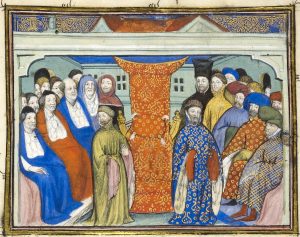 Miniature of Bolingbroke claiming the crown.
So when Bolingbroke moved forward with his coronation, Hal was naturally expected to take on the role of Prince of Wales. Did he fight it? No one knows, of course, but he was very pragmatic. Perhaps he thought it was his destiny. He certainly performed his duties as expected, spending the next eight years subduing the rebellious Welsh and learning much about warfare in the process. He was annoyed that Thomas, who was made Lieutenant in Ireland, shirked his responsibilities and came back home, putting his second in command in charge. King Henry preferred Thomas at home, so he didn’t object. That drove Hal crazy, and he complained about it whenever possible.
In 1403, when Hal was seventeen, the Percies rebelled against the king and attempted to get their hands on the prince while he was relatively unprotected at Shrewsbury. Henry IV performed one of his amazing dashes across the country and arrived just in time to fight the rebels. Hal led his own contingent and received an arrow in the face that nearly killed him.
This event certainly proved his mettle and established him more firmly as Lancastrian heir.
In these formative years, if matters were uncomfortable between father and son, there were many miles between them. But after the infamous execution of Archbishop Scrope in 1405, King Henry’s health began to fail. By 1408, after the last Percy rebellion, the king experienced the first of many strokes (most likely diagnosis), followed by a major attack that Christmas. Thinking he was going to die, Henry made his will but survived, though he was never the same. Prince Hal left his subordinates to tie up loose ends of the Welsh rebellion and came to London to take his place in the Council. This is when the trouble started.
King Henry did not want to relinquish the rule he had fought so hard to retain—even to his son. There’s some evidence that Prince Hal was getting impatient to step into his father’s shoes. But King Henry had a strong advocate in Archbishop Arundel, who would put up with no nonsense from this upstart prince. Arundel was literally the power behind the throne, and had been for many years. For some time, he called the shots, but by 1410 it was clear that Prince Hal was gaining the upper hand, and Arundel stepped back. Hal took full control of the government with the help of his uncle Bishop Beaufort and did a very good job of it, getting closer to balancing the budget which was the major problem throughout his father’s reign. But then they overstepped their bounds.
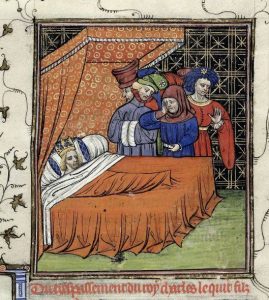
King Henry was in bad shape. He was determined to go on one more campaign, but once again at the last minute, he had to cancel. This was one time too many; Hal and Bishop Beaufort decided to approach the king and gently suggest he retire. Let Hal take up the reins. The king’s reaction was alarming and unrelenting: “I will govern for as long as I draw breath. Do you understand?” And he meant it. Shortly thereafter, Hal and his supporters on the Council were politely summoned, thanked for their services, and fired. The Prince of Wales was unemployed.
King Henry managed to revive his hidden strength and took charge once again, though inevitably it wouldn’t last long. Everyone knew it. In the meantime, Hal’s enemies, including his brother Thomas, proceeded to blacken his reputation. Already, he and Thomas had split up into different camps concerning the French civil war. Although Hal favoured Burgundy, his father decided to send aid to the Armagnacs—the party of Charles of Orléans—and put Thomas in charge. When Hal went to Coventry to raise troops, he was accused in his absence of obstructing the campaign, misappropriating funds from the Calais garrison, and, worst of all, raising a rebellion to seize the throne. Needless to say, he was horrified. By all indications, King Henry believed the accusations.
Hal’s solution seems a bit strange to me, but it seems to have sufficed. First, he wrote a memorandum denying all the rumours and sent it to every part of the realm, explaining his position. Then he returned to London with a big entourage—not an army—made his confession, and paid a visit to his father at Westminster. In front of witnesses, he knelt before the king and proffered a dagger, hilt forward. If his father believed these accusations, Hal stated, he should plunge it into his heart for he did not want to live.
Taken aback, King Henry paused, broke into tears, threw the dagger aside and drew Hal into his arms. All was forgiven and Hal was publicly exonerated. Nonetheless, Thomas proceeded to France in charge of the army and Hal stayed at home. The king made it through the next couple of months, but finally his health gave out and he was carried into the Jerusalem Chamber at Westminster, where the last scene was played out, much like Shakespeare depicted. Henry told his son that he was concerned about Hal’s relationship with Thomas, which could tear the country apart. Hal’s answer was: “Father, I will love and honour my brothers above all men so long as they remain true to me. But if they conspire or rebel against me, I assure you that I shall as soon execute justice upon any one of them as upon the worst and simplest person within your realm.” (Or so the historians tell us.) Henry was content. He handed the crown to Hal and told him to wear it well.
And that very night, as King Henry IV passed on, Hal spent the night in confession with the anchorite who lived in a cell at the abbey. The next morning, he came out as a changed man. Perhaps, in those final moments with his father, Prince Hal came to a clear understanding about the burden he was about to carry.
But one more thing. One of the first actions Henry V took in his new reign was translate King Richard II from his undignified grave in King’s Langley to his magnificent tomb in Westminster Abbey. He even borrowed the fabric trappings used at Canterbury during Henry IV’s funeral. Was this a grand demonstration to legitimize his claim to the throne, or a heartfelt gesture to a surrogate father? No one will ever know.
****
Thank you, Mercedes! and now onto the book, The Agincourt King
Blurb:
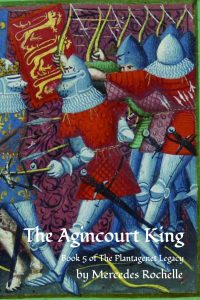 From the day he was crowned, Henry V was determined to prove the legitimacy of his house. His father’s usurpation weighed heavily on his mind. Only a grand gesture would capture the respect of his own countrymen and the rest of Europe. He would follow in his great-grandfather Edward III’s footsteps, and recover lost territory in France.
Better yet, why not go for the crown? Poor, deranged Charles VI couldn’t manage his own barons. The civil war between the Burgundians and Armagnacs was more of a threat to his country than the English, even after Henry laid siege to Harfleur. But once Harfleur had fallen, the French came to their senses and determined to block his path to Calais and destroy him.
By the time the English reached Agincourt, they were starving, exhausted, and easy pickings. Or so the French thought. Little did they reckon on Henry’s leadership and the stout-hearted English archers who proved, once again, that numbers didn’t matter when God was on their side.
Buy Links:
This title is available to read on #KindleUnlimited.
Universal Buy Link: https://books2read.com/u/mq70Ze
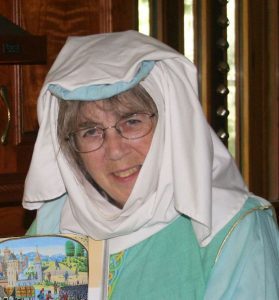 Mercedes Rochelle is an ardent lover of medieval history, and has channeled this interest into fiction writing. Her first four books cover eleventh-century Britain and events surrounding the Norman Conquest of England. The next series is called “The Plantagenet Legacy” and begins with the reign of Richard II.
She also writes a blog: www.HistoricalBritainBlog.com to explore the history behind the story. Born in St. Louis, MO, she received by BA in Literature at the Univ. of Missouri St.Louis in 1979 then moved to New York in 1982 while in her mid-20s to “see the world”. The search hasn’t ended!
Today she lives in Sergeantsville, NJ with her husband in a log home they had built themselves.
Author Links:
Website: https://mercedesrochelle.com/
Blog: https://historicalbritainblog.com/
Twitter / X: https://x.com/authorrochelle
Facebook: https://www.facebook.com/mercedesrochelle.net
Book Bub: https://www.bookbub.com/authors/mercedes-rochelle
Amazon Author Page: https://www.amazon.com/stores/Mercedes-Rochelle/author/B001KMG5P6
Goodreads: https://www.goodreads.com/author/show/1696491.Mercedes_Rochelle

Thanks so much for hosting Mercedes Rochelle today, with such an interesting post about the complex relationship Henry had with his father.
Take care,
Cathie xx
The Coffee Pot Book Club
I agree: interesting post! Not that I was surprised…
Thanks so much for hosting me, Anna! Greatly appreciated
My pleasure!