

I am more than happy to have Charlene Newcomb as my guest today. Not only is she, like me, something of a medieval history gal, she is also an author I admire and respect – even if at present I’m a bit peeved about the fact that she’s planning NOT to write another book. Hello!!! Yes, you must! I mean, what happens after Rogues and Kings, hey? You can’t leave us (and England) in the lurch!!!! Right: Anna, cool down. After all, today is about Char’s very recently released Rogues and Kings, so maybe give her a breather.
FYI, my review can be found further down in this post. But first, a guest post.Now, central to Rogues and Kings is King John. And his treasure. Not that he goes about hissing “my precioussssss”, but our royal gent keeps a very beady eye on his valuables. Until he no longer can… Allow me to turn you over to Char so that she can tell you more about that!
*****
King John and The Wash
I can’t remember when I first learned about The Wash. It was likely in an article or book I read when researching Prince John, though my focus then was on his attempted coup (1193-94) against his brother King Richard in my Battle Scars series, not on the disaster that befell King John’s baggage train in October 1216.
In that series, I’d established my version of an origins story for Robin Hood and his band of Merry Men.

The end of Battle Scars lets readers use their imaginations as to the lives of the main characters post-King Richard’s death in 1199. I hadn’t planned to write a Robin story, but never say never, right? Now here I am, picking up Robin’s life 16+ years later with Tales of Robin Hood (Rogue; and Rogues & Kings).
So why do I mention The Wash? What is The Wash?
 The Wash England – by Goran_tek-en is CC BY-SA 4.0, and this image is cropped from the original
There’s a fascinating bit of history about The Wash and ‘bad’ King John. The Wash is the largest natural bay along England’s east coast and skirts Lincolnshire and Norfolk, and at least 4 rivers feed into it. The coastline has changed – reclaimed land, rivers re-routed – in the 800+ years since John’s reign but even in 1216 it was sandy with mudflats and marshes, with shifting shallow water and deep channels affected by the tides of the North Sea.
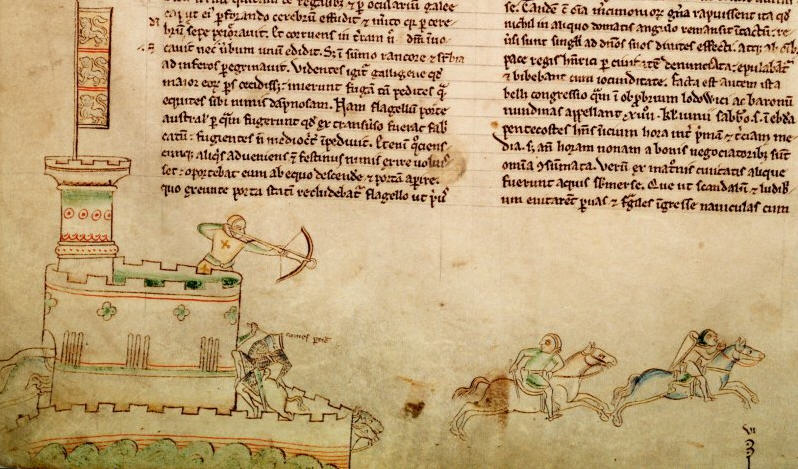
 King John estuary by ©Michael Allan Marshall, https://www.desiderata-curiosa.co.uk/kingjohn.htm
King John, who had signed and then rejected the terms of Magna Carta in 1215, had taken up war against his rebellious barons and ravaged the English countryside. (The rebels did their fair share of pillaging, too.) The French had invaded England and the barons had pledged their fealty to Prince Louis (son of King Philip of France). They held London, taken hold of many castles and towns in the south, and were actively besieging Dover Castle.

King John’s Baggage Train
An army on the move must transport its provisions from place to place. And in John’s case, everything related to the daily business of the crown travelled with him. He had no headquarters to return to after the daily ravaging of the countryside. He marched his army 15-30 miles a day destroying goods and crops – anything belonging to the rebels or that could be used by them or the invading French. His wagons held official documents, supplies, coin to pay his troops, and many personal goods including the king’s wardrobe, holy relics, and precious jewels. Chronicler Matthew Paris wrote, ‘in addition to ‘arms, tents, and victuals’, the baggage train contained ‘the things which the king, next to his life held too dear in the world’.
Contemporary chroniclers and historians tell us King John and his army had spent a couple of days in Lynn (aka Bishop’s Lynn and now called King’s Lynn) before departing on October 12. There is disagreement as to whether John travelled a different route than his slow-moving baggage train, but it headed north across The Wash.
With a guide, certain areas of the land could be crossed safely at low tide. Recent studies have suggested a tidal surge occurred as the tide receded – a great rush of water swifter than usual, and this one during a new moon.
“On days closer to new and full moons, the water can outrun a galloping horse. By Olson’s calculation, on that fateful October day in 1216, the sun and moon’s alignment magnified their impact on tides, triggering a phenomenon called a “perigean spring tide.” This phenomenon, which happens only once every 13 months, spawned a “tidal bore,” a massive wave responsible for drowning King John’s convoy.” –https://news.artnet.com/art-world/the-hunt-king-john-lost-crown-jewels-2456022
The king’s baggage train was inundated by the rising water. Historians have debated how many wagons, horses, lives, and goods were lost. From inventories the previous year, it’s possible that regalia – including a splendid crown and swords from his grandmother, the Empress Matilda – may have been lost to the sands along with John’s own regalia. His personal goods – jewels, crowns, belts, swords, etc. – might have been held at one or more of his loyalists castles; others suggest his relics were pilfered by those with him when he died, and then melted down.
The fact remains that none of the items noted in the inventory have surfaced. Washed out to sea? Buried under layers of sand, sucked into the quickland? A research report by Michael Allan Marshall suggests the goods might be buried at a depth of 20-30 feet. Even with today’s sophisticated tools, recent diviners and metal detectorists have turned up no sign of the king’s treasure. Maybe someday we’ll have an answer.
*****
Thank you, Char – and now, let us leap ahead to the book!
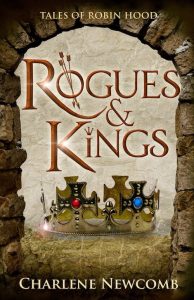
Rogues & Kings
A Gritty Robin Hood Retelling in 13th Century England
By Charlene Newcomb
Deadly secrets. Hidden identities. A true enemy.
Silence is the only shield.
The year is 1216 and civil war rages in England. King John ravages the countryside against rebellious barons and a French invasion. Unbeknownst to him, his newest squire, Richard, is in fact the son of a man the king would hang without a second thought. A man the common folk call Robin Hood.
For years, Robin has lived as a knight in exile. But when his son is ensnared in the treachery of the royal court, Robin is forced out of the shadows, aided by his outlaw friends in the Hood.
There is no question for Richard where his loyalties lie but it’s more than his own life at risk. He has the trust of a dangerous king. Can he serve the Hood better from within John’s inner circle, or will schemes against the crown unravel?
Rob from the rich, give to the poor takes on a whole new meaning.
Rogues & Kings is a sweeping tale of courage and betrayal in a kingdom on the edge of ruin, of a boy coming of age in the midst of war, and of legends being born.
Buy link: https://books2read.com/RoguesKings

My Review:
England in 1216 is not exactly a happy place, torn asunder as it is by civil war. King John is beleaguered by rebels, by the threat of invading French, and is riding from one place to the other in his kingdom to reinforce royal control. Brutally. Villages burned to the ground, ripening fields set ablaze—England smells of soot and wet ashes.
New to the royal court is Richard, the king demanding his services to ensure his father’s loyalty. The king is in two minds about Sir John Le Grand, and hopes that having the son close will keep Sir John on the straight and narrow. Except Richard isn’t the son of Sir John Le Grand, a.k.a. Little John—he is the son of a man King John detests: Robin du Louviers. Should John find out, he may well use Richard to force Robin to step out of the shadows where he has lived for years as Robin FitzWilliams.
Richard has no choice but to serve the king but decides to use his position to ferret out information for his father and his outlaw friends, loosely banded together in the Hood gang. And when Richard realises the king is travelling with his entire treasure, the outlaws, led by Allan of the Hood, decide to do some serious wealth redistribution.
Things are complicated by the sudden appearance of Robin’s beloved wife, of Little John’s heavily pregnant daughter and her rebel husband. How is the Hood to keep all these moving pieces—including themselves—safe while planning their biggest heist ever?
Ms Newcomb delivers a fast-paced, tense plot, complete with a cast of deliciously complex characters, be it the cruel King John (who has his odd, kinder moments), Nichola de la Haye or the men of the Hood. Allan, John, Marion Robin, Stephan and Henry are all well-known (and loved) characters from Ms Newcomb’s previous books, but in this book they play supporting roles to Richard, a boy that is quickly becoming a man—in every way.
Add to this vividly described settings—Ms Newcomb’s description of the events involving the king’s baggage train and the Wash is fabulous—the author’s evident understanding of the period she is describing, and Rogues and Kings is one of those books this reader devours, finding it quite impossible to put it down. An excellent read!
***
Charlene Newcomb, aka Char, is a retired librarian, a U.S. Navy veteran, mom to 3 amazing humans, and grandma to 3. She writes historical fiction and science fiction. Her award-winning Battle Scars trilogy is set in the 12th century during the reign of Richard the Lionheart. Her writing roots are in the Star Wars Expanded Universe (aka Legends) where she published 10 short stories in the Star Wars Adventure Journal, and published the original novel Echoes of the Storm. Char returned to medieval times with Rogue and her latest novel Rogues & Kings, both in her Tales of Robin Hood series.
Find Char
Website: https://charlenenewcomb.com
Facebook: https://facebook.com/CharleneNewcombAuthor
Substack: https://charlenenewcomb.substack.com/
What kind words, Anna! An awesome review. :) Thank you for hosting me on your blog. Your cheerleading, and your friendship, mean so much.