


After yesterdays brief stop in the Roman Empire, we are now back in Britain. It is the time of Arthur, of Guinevere and the Round Table. Except that in Helen Hollick’s take on Arthur, Guinevere is Gwenhwyfar and in no way a retiring violet. Helen writes marvellous female characters, and I personally think her take on Guinev–oops! Gwenhwyfar – is both intriguing and realistic. So, take Helen by the time and leap back to the late 5th (or early 6th) century!
Gwenhwyfar (Guinevere) One Cool Dude Lady?
Does anyone not know the familiar story of Guinevere: young wife to an ageing King Arthur, lover of Sir Lancelot, her husband’s best and most trusted (!) friend? She was (supposedly – more of that in a minute) an early-medieval queen of Great Britain, mentioned for the first time in the early 12th century in Geoffrey of Monmouth’s pseudo-historical British chronicle Historia Regum Britanniae. She has been portrayed in legend, fiction and film as beautiful, regal, virtuous and modest, but also unfaithful, spoilt, a traitor and an adultress. She was also sentenced to burn at the stake but rescued.
I said, above, supposedly because (sorry folks) King Arthur never actually existed, ergo neither did Guinevere. Nor Lancelot, or Merlin – or any of them outside of the realm of story. Although there might have been some early warlord in some remote part of Britain who inspired the eventual tale. But if so, there has never been any conclusive reference to him. Nor, for the record was Great Britian ‘great’ during the Medieval period, and England wasn’t ‘England’ until the late 10th or early 11th century.
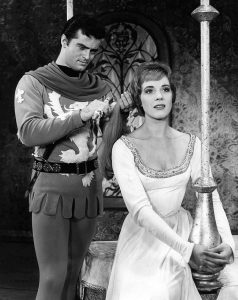 Robert Goulet as Lancelot and Julie Andrews as Guenevere from Camelot. Photo by Friedman-Abeles, New York. (©free Wikimedia)
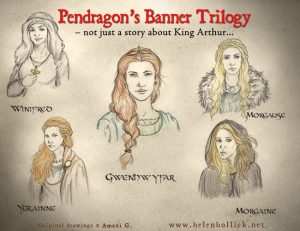
Guinevere’s original Welsh name is Gwenhwyfar, which is what I call her in my Arthurian Pendragon’s Banner Trilogy. In brief her story is: she was betrothed through necessity of alliance to Arthur, a king much older than herself. Arthur worshipped her but cleared off on a (pointless?) quest to find the Holy Grail. He was gone for years, leaving his court under the directorship of his best, most trusted mate, Sir Lancelot. Arthur’s rat of an illegitimate son, (sired on his own sister) Mordred, stirred up trouble when he discovered Lancelot wasn’t the chivalric chap they all thought him to be, on account of him and Guinevere having an affair. Arthur came back, found out, Mordred did more stirring resulting in Guinevere being condemned to die, but Lancelot rescued her and they cleared off to live happily ever after. Meanwhile, Mordred declared war, the battle of Camlann was the result and both Arthur and Mordred were killed. End of the Golden Age of Arthur.
All of which reflects the Medieval courtly romantic tales during the age of Henry II, Eleanor of Aquitaine, Richard the Lionheart, King John, Edward I and so on. And had absolutely nothing to do with the real period of Arthur IF he’d existed, which is the 5th–6th centuries between the going of the Romans and the coming of the Anglo-Saxons.
So, how does my Gwenhwyfar and my trilogy differ from the legends, and why did I write it?
First, some background: The Kingmaking, (#1) Pendragon’s Banner (#2) Shadow of the King (#3) was originally accepted for publication by William Heineman (Random House UK) a week after my 40th birthday back in 1993. Yep, the Trilogy has been in print (one way or another via various publishers and now my own UK self-publish) for over thirty years. Let down by the decrease of popularity for historical fiction and my ex-agent’s lethargy, the books didn’t do as well as they should have done, – something I will always regret and never forgive the ex-agent for.
I have never been particularly interested in the Medieval Arthurian tales. I can’t strand goody-two-shoes Lancelot, and I didn’t much like the silly Guinevere. Nor Arthur, to be honest. The Knights In Armour slant didn’t seem plausible or believable. Then I discovered Mary Stewart’s Crystal Cave and Hollow Hills, good stories, albeit similar to the familiar legends, but her Merlin was believable and the timeline was the earlier, post-Roman period, which I had never come across before in fiction. (This was the 1970s.) I was fascinated. Post-Roman? That made far more sense! I abandoned trying to write science fiction and turned to historical fiction – the story of Arthur and Gwenhwyfar as I thought it might have happened.
And my Gwenhwyfar was to be very, very, different!
I decided to use what few facts we had for the ‘Dark Ages’. The Anglo-Saxons and Jutes were migrating from Germany to Britain, mostly settling peacefully at first, but eventual conflict erupted when two cultures (Saxon and Romano-British/Celtic) clashed. (Yes, the ‘English’ today are descended from migrant incomers, something I often point out when we hear the inflammatory ‘England for the English’.) The 4-500s was a period of unsettlement. The Roman Empire was collapsing, it’s well-established administration along with it. Britain was on its own, if there had been an Arthur to unite the unravelling consequences this was the right period for him to have done it.
I researched Roman Britain, and went back to the earliest Welsh records. I discovered Cunedda who had been forcibly moved from Traprain Law in what is now Scotland, to what is now Gwynedd in North Wales. He had a brood of sons, so I quite happily included a daughter for him. (After all, the daughters were rarely recorded.) Enter Gwenhwyfar.
My fictional Gwenhwyfar is what we now call ‘feisty’. Brought up with nine brothers she knew how to fight and defend herself. Knew how to ride horses… how to survive. When the boy, Arthur, came into her life it was not love at first sight (in fact, the opposite), but their feelings were to change – and cutting a long story short (an entire Trilogy!) their relationship was to be an enduring one, albeit fused with disagreements and complications, as is real life between two strong, determined, opinionated people. Sparks fly but love is always there, even if it is sometimes squashed by dark shadows.
My Gwenhwyfar stayed loyal to the man she loved, Arthur. My Gwenhwyfar was to have three sons and a daughter, my Gwenhwyfar was to experience great happinesses and deep sorrows. My Gwenhwyfar rode to war alongside Arthur when she could. My Gwenhwyfar would never, never, have been smitten by the soggy charm of a flawed knight. No spoilers, but even when she thought Arthur was dead she stayed loyal to him.
I still receive emails from readers who read, kept and treasure those original versions. These many years later, I have republished new UK editions with stunning covers designed by www.avalongraphics.org. (Alas, I have no control over the out-of-date US versions. The publisher turned down the free offer to use the new covers.)
The ultimate accolade for my Gwenhwyfar? I was being bullied by a fellow parent at my daughter’s school. I was walking home one morning and realised this man was following me. I waked quicker, so did he. I was starting to feel scared, then I thought, “What would Gwenhwyfar do?”
I imagined a sword in my hand. Turned around, smiled sweetly and said, “Do you want something?”
He went bright red and scuttled off in the opposite direction. Never bothered me again.
So, fictional characters, strong women especially, have their uses…
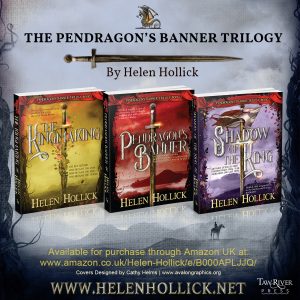
ABOUT THE PENDRAGON’S BANNER TRILOGY
The Kingmaking: Book One
Pendragon’s Banner: Book Two
Shadow of the King: Book Three
The Boy: Who became a Man
Who became a King:
Who became a Legend…
KING ARTHUR
There is no Merlin, no sword in the stone, and no Lancelot.
Instead, the man who became our most enduring hero.
THE KINGMAKING – Book One
All knew the oath of allegiance:
‘To you, lord, I give my sword and shield, my heart and soul. To you, my Lord Pendragon, I give my life, to command as you will.’
This is the tale of Arthur made flesh and bone. Of the shaping of the man who became the legendary king; a man with dreams, ambitions and human flaws. A man, a warlord, who united the collapsing province of post-Roman Britain, who held the heart of the love of his life, Gwenhwyfar – and who emerged as the most enduring hero of all time.
A different telling of the later Medieval tales.
This is the story of King Arthur as it might have really happened…
YouTube Trailer (an old trailer – but the gist is still relevant!) : http://www.youtube.com/watch?v=Ud4d_ZcyLdg
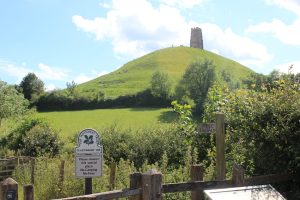 Glastonbury Tor, copyright Cathy Helms
READ AN EXCERPT: (from The Kingmaking August 455)
Gwenhwyfar knew something was to happen. Not precisely when, but soon, very soon. It was an odd feeling this, something inside niggling like an image vaguely remembered after a waking dream. For the past week she had climbed the Tor each morning, settled herself close by the largest standing stone on the summit and watched. For what, she did not know, just watched.
It was not a Christian place, this Tor, the Holy Sisters did not like her walking here. Yns Witrin it was called, the Glass Isle. Even in the driest of summers there was always water spread around the foot of this conical hill – sodden places, marsh oozing underfoot, pitted with deeper bog that could trap and drown the unwary. Come winter, or after weeks of rain such as this year had brought, the low flat levels became a plain of dotted lakes and running channels. The brooding height of the Tor reflected in those vast, mirroring waters. An imaged island as delicately translucent and brittle as glass. Shrouded in morning mist and with its ancient miz-maze path winding back and forth in ritual pattern up the steep slopes, the Tor squatted over a cluster of little hills, like a matriarch presiding over her mixed brood sheltering within the fall of her shadow.
It might not be Christian, but it was a revered and mystical place. A sanctum of the Old Ways, of the Mother Goddess and Avallach, God of the Underworld. She danced on the buttercup-spotted or frost-rimed grass. He slept beneath, in his domain of Avalon within the darkness of the hollow hill, waiting for the souls of the dead to find their way by night down the passages into the Other World.
Once, there had been many who served the Goddess; now the young women went to the Christian Mother. Daughters learnt the litany of the Holy Church, not the ancient learning of a goddess who was sliding into obscurity. Only three priestesses were left down there at the base of the Tor in their poor dwelling houses. Theirs was an ancient, once elite, clan. ‘The Ladies’, they were called: women of the Goddess. With the passing of the three, that goddess would be gone from the Tor. Forgotten.
Drawn to this richly spiritual place, Christian people had settled their community among the cluster of hills set on the flat of the Summer Land. They had built their little chapel and crude dwellings; set up their market place and expanded as each year more came. The chapel became a church, the crude dwelling houses merging together into cloistered orders where men and women could live and work alongside God and Christ. Traders arrived. Farmers brought their produce and cattle to the market and prospered; a tavern flourished to provide bed and food for weary travellers who came to worship at the wondrous-built church, or seek healing or learning from the holy men and woman. Under the Christ God the Glass Isle thrived.
It may have been very pagan, this Tor that hovered above the mist of a damp spring or autumn morning, or floated on a flood plain of glistening, sky-bright water, but Yns Witrin possessed a pull of awe and inspiration. A place where it was easy to listen to the voice of your God. Within the spirit of the Tor, you could see through the shaded windows of your own soul. And the Tor was a place of the Mother. Whether she were the old Goddess or the Virgin Mary, mother of Christ, she was still the Mother. Gwenhwyfar had been safe here under her protective wing. A place for the female. A sanctuary where time drifted with the moon cycle and where the earth beneath your feet understood the pain of labour and the joy of birth.
SOME REVIEWS:
“If only all historical fiction could be this good.” Historical Novels Review
“… Juggles a large cast of characters and a tangled plot with great skill. ” Publishers Weekly
“Hollick’s writing is one of the best I’ve come across – her descriptions are so vivid it seems as if there’s a movie screen in front of you, playing out the scenes.” Passages To The Past
“Hollick adds her own unique twists and turns to the familiar mythology” Booklist
“Uniquely compelling… bound to have a lasting and resounding impact on Arthurian literature.” Books Magazine
BUY LINKS:
Kingmaking: https://mybook.to/TheKingmaking_Book1
Banner: https://mybook.to/PendragonsBanner_Book2
Shadow: https://mybook.to/ShadowOfTheKing_Book3
THE PENDRAGON’s BANNER TRILOGY
https://mybook.to/KingArthurTrilogy
 First accepted for traditional publication in 1993, Helen Hollick became a USA Today Bestseller with her historical novel, The Forever Queen (titled A Hollow Crown in the UK) with the sequel, Harold the King (US: I Am The Chosen King) being novels that explore the events that led to the Battle of Hastings in 1066. Her Pendragon’s Banner Trilogy is a fifth-century version of the Arthurian legend, and she writes a nautical adventure/supernatural series, The Sea Witch Voyages. She has also branched out into the quick read novella, ‘Cosy Mystery’ genre with her Jan Christopher Mysteries, set in the 1970s, with the first in the series, A Mirror Murder incorporating her, often hilarious, memories of working as a library assistant. The fifth in the series, A Memory Of Murder, was published in May 2024, with more to follow!
Her non-fiction books are Pirates: Truth and Tales and Life of A Smuggler. Latest on her writing list is a book about the ghosts of North Devon, and Jamaica Gold the seventh Sea Witch Voyage.
She lives with her family in an eighteenth-century farmhouse in North Devon with their dogs and cats, while on the farm there are showjumper horses, fat Exmoor ponies, an elderly Welsh pony, geese, ducks and hens. And several resident ghosts.
Website: https://helenhollick.net/
Amazon Author Page: https://viewauthor.at/HelenHollick
Facebook: https://www.facebook.com/helen.hollick
Blog: supporting authors & their books
https://ofhistoryandkings.blogspot.com/
Monthly newsletter: Thoughts from a Devonshire Farmhouse
(posted on her blog – subscribe to a ‘reminder’ list)
Start Here: January 2024
check out the previous Marching through history post HERE
This is such an intriguing perspective on Gwenhwyfar / Guinevere – worthy of its very own place in the legends. Loved it! (Soggy charming knight…Lol!)
Thank you Elizabeth :-)
I loved your Arthurian trilogy (as you know, lol – I’m such a fan 😆).
I was never too keen on the original, dusty, wishy-washy chivalric version. Yours paints a vibrant picture of ancient times with a very believable warlord. You took a dusty old legend and brought its blurry edges into sharp, colourful life.
I must have had the three books for twenty years or so and read them all at least three times. Fabulous writing.
Thank you Loretta
I read these years ago and loved them. I might have to dig them out and read them again!
Not ‘might’ … but definitely LOL
I’ve never liked how Gwenhwyfar was portrayed in the Arthur stories either, and I don’t think she was ever served well. The way you shaped this Gwenhwyfar as a feisty strong woman better represents the time and makes for a beloved character. I also loved how Mary Stewart portrayed Merlin in the Crystal Cave series as well as the era she set the stories in.
thank you Cryssa
I agree: the Guinevere of the Arthurian legend is hard to relate to – and I always found it utterly incredible she’d develop a passion for anyone, not even when the dude in question was Lancelot
I never liked Lancealot – was delighted when I discovered that I could write a novel without him!
Thank you Anna – and thank you everyone for your lovely comments.
Mwah!
Helen, you are the ideal writer to create a true heroine for the ages in your fictional Gwenhwyfar. Fabulous post!
Thank you!
I MUCH prefer your Gwenhwyfar to soppy Guinevere. Perhaps portraying Guinevere as the faithless, weak woman was the patriarchy in full rampant mood?
Now I must go back and re-read yours.
yes you must! LOL
I very much enjoyed this, Helen. I can’t be sure I read your books in the 1990s (possibly)but I have read a number of ‘Arthurian’ novels set in the post-Roman era in more recent years. Setting Arthur in the CE 400s/500s onwards is more credible to them, as it was to you earlier.
Apart from Mary Stewart I think I was among the few first fiction authors to set Arthur in post-Roman Britain – and one of the first to not include Lancealot or Merlin.
Helen – thank you for sharing your version of Gwenhwyfar. I much prefer her feisty!
Thank you!